Since 1981, The Institute of Holocaust & Genocide Studies at Raritan Valley Community College has offered educational programs for teachers, students, and the broader community. Through our unique programming, the Institute—a collaboration between RVCC and the Jewish Federation of West-Central New Jersey (formally known as the Jewish Federation of Somerset, Hunterdon & Warren Counties) —promotes historical awareness and greater understanding to address the implications of historical events in the world today.
The Institute of Holocaust & Genocide Studies offers a range of services and programs for middle and high school students/educators, students on campus, college faculty, as well as the broader community, such as:
- Outstanding educational events and exhibitions
- Informative educator workshops
- Engaging webinars
- Thought-provoking presentations
Additionally, “Learning Through Experience,” the Institute’s cornerstone educational program, began as a one-day event more than 40 years ago and has educated more than 150,000 middle and high school students and educators with an extraordinary series of guest speaker workshops addressing the Holocaust and genocide. We are now pleased to offer Learning Through Experience both virtually and in person.
The work of the Institute is also a vital part of the educational experience on campus. The Morris and Dorothy Hirsch Research Library is located on the second floor of the College’s Evelyn S Field Library. In addition to housing the traveling exhibits the Institute brings to campus, the Hirsch Research Library offers books, a video collection, reference materials for research and study, and an area for classroom instruction. The research library provides a wealth of new and current information directly connected to the programs and events offered by the Institute of Holocaust and Genocide Studies. RVCC professors and educators in the wider community are encouraged to bring their classes to see the exhibits on display and check out the new books currently available.
For information regarding programming, resource information, or annual events, contact Michelle Edgar, Program Specialist, michelle.edgar@raritanval.edu, 908-526-1200, x8735.
Follow us on Facebook
_______________________________________________
PROGRAM SCHEDULE
The Raritan Valley Community College Institute of Holocaust and Genocide Studies will present its 6th annual virtual Summer Book Series beginning in June. The series, which is free of charge and open to the public, will begin June 12. The segments will be held via Zoom webinars and registration is required.
The following programs will feature three, new, historical fiction novels that explore the past:
The Sisters of Book Row by Shelley Noble
June 12, 10-11 a.m.
The Sisters of Book Row (2026) by Shelley Noble, set in 1915 Manhattan, focuses on three sisters who run a rare bookshop on “Book Row” and their fight against censorship by American anti-vice activist Anthony Comstock. The story follows Olivia, Daphne, and Celia Applebaum, who, inspired by real historical events and figures like Margaret Sanger, protect literature and secretly distribute women's health information. It’s a story of family, loyalty, and the fight for the freedom to read. Register for the June 12 discussion

Keeper of Lost Children by Sadeqa Johnson
July 17, 10-11 a.m.
Keeper of Lost Children (2026) by Sadeqa Johnson follows three characters in postwar Germany (1950s) and 1965 Maryland. It focuses on the “Brown Babies”—mixed-race children who were left behind after WWII. Ethel Gathers, a character based on the real-life Mabel Grammer, works to save these children. In the course of Mrs. Gather’s mission to help, her life intersects with soldier Ozzie Phillips and teen Sophia Clark. It’s an inspirational novel about how one person can make a difference in the lives of so many. Register for the July 17 book discussion

The Last Woman of Warsaw by Judy Batalion
August 21, 10-11 a.m.
The Last Woman of Warsaw (2026) by Judy Batalion follows two young Jewish women—social activist Zosia and aspiring artist Fanny—in 1938 Warsaw. As antisemitism rises, they unite to find their missing photography professor, bridging their different worlds while navigating personal crises and the vibrant, doomed culture of pre-war Poland. Register for the August 21 book discussion
__________________________________________________________________
March 2027

Hidden
Friday, March 19, 10am
The Nash Theatre
HIDDEN, a new, original musical based on the true story of Ruth Kapp Hartz, who was a "hidden child" as a young Jewish girl in France during World War II is coming to Raritan Valley Community College's Nash Theatre in the Spring of 2027!
HIDDEN is1 hour in duration. Following the show, there will be a talk-back, allowing participants to enter into discussion with the writers, director and cast, as well as with Ruth herself. The show is intended for schools (grades 4-12). This show is free for students, teachers, & administrators, but registration is required. Contact Michelle.Edgar@raritanval.edu for more information.
These programs are free and open to the public, but registration is required. If you have any questions, Contact Program Specialist Michelle Edgar at Michelle.Edgar@raritanval.edu.
The Jewish Federation of West-Central New Jersey is our co-sponsor. https://www.jfedwcnj.org/


Anne Frank Sappling
RVCC Received Sapling from Original Tree Mentioned in Anne Frank’s Diary
In June 2024, RVCC is privileged to receive a sapling from the original tree in front of the Annex, where Anne Frank and her family had remained hidden for more than two years. As one of the Anne Frank Sapling Project recipients from the Anne Frank Center USA, we will honor Anne Frank's memory and join a coalition of organizations committed to education, free expression, and belief in humanity.
We are incredibly grateful to the Anne Frank Center USA for choosing RVCC as one of the honored recipient organizations. More information and updates to come!

The Light from the Yellow Star Project
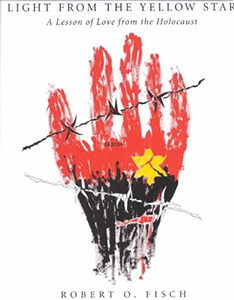
ABOUT THE LIGHT FROM THE YELLOW STAR PROJECT
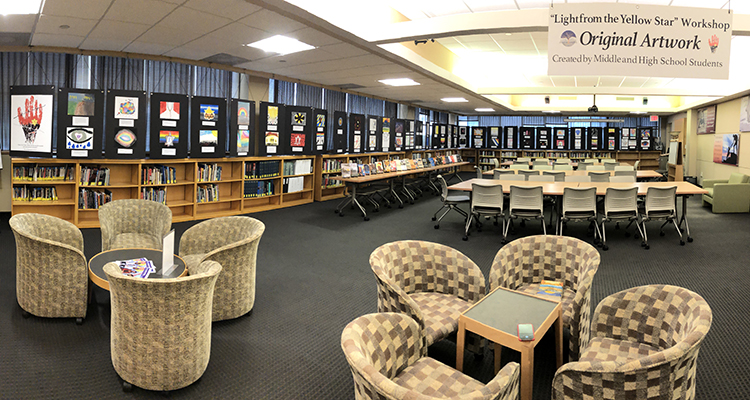
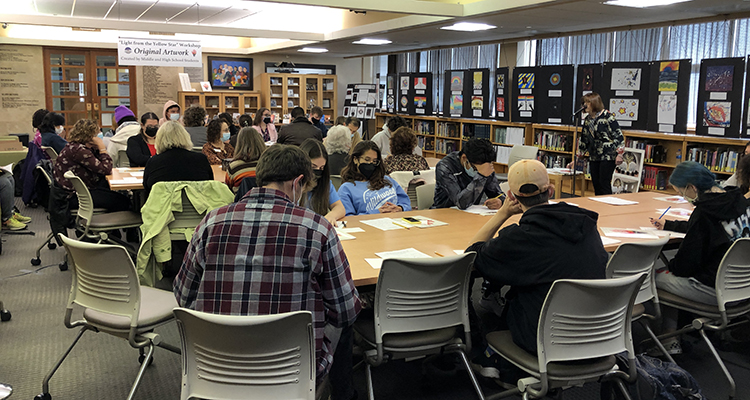
Students in the light from the Yellow Star Project first read Robert Fisch’s survivor memoir while viewing his illustrative artwork. With Nancy Gorrell as facilitator, students then chose the piece that “spoke to them the most” to relate to their knowledge of the Holocaust. Following the survivor reading, students engaged in a discussion about Holocaust art with Evelyn Rauch, designer of the center’s Holocaust Memorial who shared her work with the students. As a Second Generation Holocaust Survivor, Evelyn empowered students to create their own responses as a post – Holocaust generation. Students and their teachers were given a variety of artistic tools and materials to create their own artistic response inspired by Robert Fisch’s work and what they had seen, heard, and felt deeply.
This outreach workshop was developed by Nancy Gorrell and Evelyn Rauch from Nancy Gorrell’s award winning article, “Teaching the Holocaust: Light from the Yellow Star Leads the Way,” English Journal (Dec. 1997).
Sponsored by the Margit Feldman Educational Endowment Fund and Temple Sholom Cemetery Society Education Endowment Fund.
THE LIGHT FROM THE YELLOW STAR PROJECT was made possible by a grant from the New Jersey Council for the Humanities, a state partner of the National Endowment for the Humanities. Any views, findings, conclusions, or recommendations expressed in THE LIGHT FROM THE YELLOW STAR PROJECT do not necessarily represent those of the National Endowment for the Humanities or the New Jersey Council for the Humanities.
Explore The Light From the Yellow Star Art Exhibition at RVCC in 3D
Watch The Light From the Yellow Star Workshop, recorded on October 28, 2022
Our Mission
The mission of the Institute of Holocaust & Genocide Studies is to educate students and the wider community about the dangers of intolerance, to learn together, and to find a deeper appreciation for our shared humanity.
Our goals are:
- Promote awareness, understanding, and compassion of the suffering of others
- Share the lessons learned from the Holocaust by identifying the danger signals in prevention of other genocides
- Serve as a repository of various educational materials, including audio visual and literature, about diversity, the Holocaust and genocides for research, study, and to provide educators with the tools to teach these complex histories
- Evoke reflection and remembrance
- Encourage active community participation in combating bigotry and hate through social action
In Memory of Margit Feldman
Community Holocaust Remembrance Day Event in Honor of Margit Feldman, Wednesday, January 27, 2021 - Click here to view
In Memory of Margit Feldman
We would like to remember Margit Feldman, a founding member of the Institute of Holocaust and Genocide Studies. Margit worked tirelessly to help educate students and the wider community about the Holocaust. Margit inspired thousands of people when they heard about how she survived the Nazi concentration camps. Her powerful yet gentle presence will be missed. For more information about Margit, you can find her book, Margit: A Teenagers Journey Through The Holocaust and Beyond and the documentary, Margit: Not A23029, detailing her life.
If you would like to donate to The Institute of Holocaust and Genocide Studies, in honor of Margit Feldman, please use this link: Give Now
We will be sure to direct the funds toward our Learning Through Experience Program, of which Margit has always taken part. If you have any questions, please contact Michelle Edgar, Program Specialist for the Institute of Holocaust and Genocide Studies at Michelle.Edgar@Raritanval.edu.
“What I will always remember about Margit was her belief in humanity and the power of each individual to effectuate positive change. Margit was a huge proponent of education; she was one of the original founders of Raritan Valley Community College’s Institute for Holocaust and Genocide Studies and was instrumental in developing the Institute’s Learning Through Experience Program. Through the Learning Through Experience Program, middle school and high school students would not only learn about the horrors of the Holocaust and other genocides, but also would learn about compassion, perseverance, resilience, and supporting human rights. Margit’s greatest joy in the Learning Through Experience Program came from meeting face-to-face with young students and encouraging them to be active promoters of justice. Through the Institute’s Learning Through Experience Program, Margit has touched the lives of thousands of individuals and left an enduring legacy at the College. Housed in The Morris and Dorothy Hirsch Research Library of Holocaust and Genocide Studies is a collection of videos, photographs, and books about Margit’s triumphant life. I can recall Margit and her husband Harvey walking side-by-side into the Institute’s Resource Center to participate in an advisory meeting with one important goal in mind – how to make the world a better place for all. Raritan Valley will honor Margit’s legacy by continuing her work to make the world a better place, and when we can reconvene collectively as a community, the Institute for Holocaust and Genocide Studies will properly celebrate Margit and her lifetime of achievements.”
--Jacki Belin, Vice President for Student Affairs and Outreach, Raritan Valley Community College
"Margit - Not A23029"
password: margitjcc
To honor the memory of Margit Feldman, one of the founders of The Institute of Holocaust and Genocide Studies at RVCC, we would like to share this documentary film, Margit - Not A23029. This film is about Margit's life after the Holocaust. We learn that while the Holocaust had a major impact on Margit's life, Margit was not just a survivor of Auschwitz. Margit was a survivor, wife & mother, grandmother, & educator.
This film contains graphic historical footage. Viewer discretion is advised. This film is not meant for distribution or to be shared.
This is a copy of the film. A higher quality version will eventually replace this version.
Margit Feldman by Evelyn Rauch
Margit how will we go on with out you?
You were the face of the Holocaust.
You were the will of survival
You were the hope of a better tomorrow
Margit when I close my eyes I see your beautiful angelic face
I hear you call me honey and I feel your gentle touch on my shoulder
I see you surrounded by children hanging on your every word
I hear the echo of your voice telling us how to survive.
Margit you inspired so many of us to use our voices against anti Semitism
You taught us to value our differences and find our commonalities
You spoke from the strength of a true survivor
You held our hand
Margit you empowered us to always do better
You instructed us to educate those who were in the dark
You showed us the light
You demanded our attention.
Margit who will be the mother of all mothers to us now?
No one will ever be able to take your place
No one will ever be able to relate your story the way you did
No one will speak with the passion and conviction you had.
Margit we will try to carry on your legacy
You were our teacher and our mentor
So rest easy my dear Margit knowing we will carry on in your memory
We will continue to tell your story
Margit the world will never be the same
You have made a difference in everyone who knew you
You have empowered generations to promote understanding
Your yellow star has turned to gold shining down on all of us.
Thank you Margit Feldman for all you have done for all of us.
Learning Through Experience
“Learning Through Experience,” the Institute’s cornerstone educational program, began as a one-day program more than 39 years ago and has educated more than 150,000 middle and high school students and educators with a unique series of guest speaker workshops addressing the Holocaust and genocide. Learning Through Experience is now offered both virtually and in person. For information regarding programming, resource information, or annual events, contact Michelle Edgar, Program Specialist, (908) 526-1200, extension 8735.
Institute of Holocaust & Genocide Studies Webinars
- A Yom HaShoah Commemoration Tuesday, April 14th, 2026
- Anne Frank - Her Life and Surprising Legacy, with author Gillian Perry - Friday, September 19, 2025 - click here
- Online Discussion with Author Anna Salton Eisen - December 6, 2024 - click here
- Hear Bubi Sarah’s extraordinary story with Dave Reckess, Executive Director of 3GNY & Grandchild of Holocaust Survivors - October 28, 2024 - click here to view
- Meaningful Moments and Holocaust Remembrance with Maud Dahme and NJEA teachers Tamara Beatty and Lisa Hanna - Thursday, May 2, 2024 - click here to view
- The Fragility of Democracy, Reflections on the Weimar Republic, and Why the Holocaust Still Echoes in the World Today, a hybrid event with Dr. Michael Berenbaum, April 18, 2024 - click here to view
- Tree of Hope: Anne Frank's Father Shares His Wisdom With An American Teen and the World by Cara Wilson-Granat - June 12, 2023 - click here to view
- Once We Were Home Book Launch with author, Jennifer Rosner - March 24, 2023 - click here to view
- Learning Through Experience with Nadja Halilbegovich, Her Compelling Journey Through the Bosnian Genocide & Its Tragic Parallels to Ukraine. February 10, 2023 - click here to view
- Holocaust Remembrance in the Digital Age: January 26, 2023 - click here to view
- Online Opening of a NEW Exhibition, Witness to History, Keepers of Memory with Testimony from Eva Kuper, Canadian Holocaust Survivor-Friday, January 20th - click here to view
- We Are The Seeds: The Every Child Matters Movement and the Ongoing Impact of Indian Residential Schools with Katrina Herne Cosponsored by The Institute of Holocaust & Genocide Studies and 3GNY Grandchildren of Holocaust Survivors - November 16, 2022 - click here to view
- Community-Wide Kristallnacht Commemoration with Fred Behrend & Larry Hanover - November 2, 2022 - click here to view
- Community-Wide Yom HaShoah Commemoration and Remembrance with Maud Dahme - April 19, 2022 - click here to view
- "The Herero Genocide and the Holocaust: What are the Links?" February 9, 2022 - click here to view
- International Holocaust Remembrance Day Commemoration. Generations: Portraits of Holocaust Survivors. January 27, 2022 - click here to view
- Community-Wide Holocaust Remembrance Day Event: Honoring Our Survivors: Tova Friedman and Maud Dahme. January 27, 2022 - click here to view
- Learning Through Experience: The Power of One with Jeannie Opdyke Smith and Tova Friedman October 15, 2021 - click here to view
- The Number on Great-Grandpa's Arm - October 1, 2021 - click here to view
- Unpacking The Past with Silvia Foti and Grant Gochin - September 30, 2021 - click here to view
- From Swastika to Him Crow with Dr. Lillie Edwards September 24, 2021 - click here to view
- Summer Book Series with Jennifer Rosner discussing her novel, The Yellow Bird Sings. June 18, 2021 - click here to view
- Confronting the Challenging Landscape of Holocaust Research in Poland April 19, 2021 - click here to view
- Commemorating Yom HaShoah with The Defiant Requiem Foundation & Maestro Murry Sidlin, Friday, April 9, 2021 - click here to view
- Learning Through Experience with Dr. Terrence Roberts, one of the Little Rock Nine, February 5, 2021 - click here to view
- The Mission, Vision, and Work of the Jim Crow Museum: An Anti-racism facility dedicated to building a just society with Dr. David Pilgrim. January 22, 2021 - click her to view
- Syria's Secret Library: Reading and Redemption in a Town Under Seige (Community Program). November 20, 2020 - click here to view
- Learning Through Experience: Virtual tour of The Anne Frank House and hear from two Holocaust survivors. November 12, 2020 - click here to view
- ARTIVISM - the first exhibition of its kind, located at the intersection of art, human rights, and the prevention of genocide. October 23, 2020 - click here to view
- Learning from the Struggles of Racial Injustice Both Here and Abroad with Dr. Susan Neiman. September 10, 2020 https://rvcc.hosted.panopto.com/Panopto/Pages/Viewer.aspx?id=ce857547-0dc2-4836-8ee3-ac3201416e1a
- Summer Book Series with Georgia Hunter, author of We Were The Lucky Ones. June 30, 2020 https://rvcc.hosted.panopto.com/Panopto/Pages/Viewer.aspx?id=40a6896b-f444-482f-afcf-abf80106473a
30th Anniversary of the Institute for Holocaust and Genocide Studies at RVCC
- Community-Wide Yom HaShoah Commemoration with The Defiant Requiem Foundation & Maestro Murry Sidlin
The Yom HaShoah commemoration will feature a viewing of the documentary film, Defiant Requiem, followed by a discussion with Maestro Murry Sidlin, the President and Creative Director of the Foundation. This feature-length documentary film tells the extraordinary, untold story of the brave acts of resistance by Jewish prisoners at Theresienstadt (Terezín) during World War II.
Defiant Requiem Documentary Film: https://vimeo.com/483615520 Password (case-sensitive): survivingevil
Discussion with The Defiant Requiem Foundation & Maestro Murry Sidlin, Friday, April 9, 2021 - click here to view
Resilience During Challenging Times Series
In this lecture series, there are testimonies from Holocaust survivors, and their descendants intended to inspire people during challenging times. Each week we have heard from either a Holocaust survivor, an author, or a family member of the survivors who provided insight into how resilience and hope are still possible even in the most challenging periods of life. April 17, 2020 - May 29, 2020.
- Week 1:Resilience During Challenging Times: Testimonies That Provide Hope with Maud Dahme: https://rvcc.hosted.panopto.com/Panopto/Pages/Viewer.aspx?id=31fdcfb2-f4ee-4b37-99c2-abae011a24ed
- Week 2:Resilience During Challenging Times: Testimonies That Provide Hope with Bea Abrams and Janine Bernheim: https://rvcc.hosted.panopto.com/Panopto/Pages/Viewer.aspx?id=bd96c227-3a24-435c-ada9-abae011bdabe
- Week 3:Resilience During Challenging Times: Testimonies That Provide Hope with Peppy Margolis: https://rvcc.hosted.panopto.com/Panopto/Pages/Viewer.aspx?id=fdde651e-3a9a-45fa-9cb7-abb200d272e4
- Week:4 Resilience During Challenging Times: Testimonies That Provide Hope with Barbara Gilford: https://rvcc.hosted.panopto.com/Panopto/Pages/Viewer.aspx?id=520edc7c-26af-4fe7-adcc-abb50166f0ee
- Week 5:Resilience During Challenging Times: Testimonies That Provide Hope with Evelyn Rauch: https://rvcc.hosted.panopto.com/Panopto/Pages/Viewer.aspx?id=2041de0f-88fe-4a2a-96bd-abbc01738304
- Week 6: Resilience During Challenging Times: Testimonies That Provide Hope with Jessica Wang: https://rvcc.hosted.panopto.com/Panopto/Pages/Viewer.aspx?id=542ae461-a412-471b-9c49-abc800d129b1
- Week 7: Resilience During Challenging Times: Testimonies That Provide Hope with Elyse Wolff :https://rvcc.hosted.panopto.com/Panopto/Pages/Viewer.aspx?id=31f0b110-2b44-4b24-90ef-abcd00ce4027
Resilience During Challenging Times Panel - One Year Later, Friday, April 16, 2021 https://rvcc.hosted.panopto.com/Panopto/Pages/Viewer.aspx?id=907ef826-8a0a-402d-8db6-ad0d0173b3c3
Programs of the Institute of Holocaust & Genocide Studies
Learning Through Experience
Learning Through Experience, the Institute’s cornerstone educational program, began as a one-day program in 1981 and has since grown into a three-day event. More than 3,000 middle and high school students and educators participate in a series of workshops related to the Holocaust and genocides. The event features guest speakers who have experienced the consequences of hate and prejudice and have acted with courage in the face of adversity.

BEARING WITNESS
An exhibition featuring mixed-media quilts and other works of fabric art, organized in partnership with Studio Art Quilt Associates (SAQA), Inc. August 28 to December 13, 2024.
Listen to the artists of this extraordinary exhibit talk about their inspiration and their artistic process. Recorded, Friday, September 27, 2024. Click here to listen
Humanity’s shared history includes a violent and shameful component—that of deliberate attempts to eradicate specific populations due to differences in culture, religion, ethnicity, sexual orientation, gender expression, and race. These acts are often motivated by those in power, and collective trauma and tragedy are part of many people’s past and present. These themes are explored in the exhibition, which features work by artists from the United States and the United Kingdom, Israel, Germany, Italy, and Canada. Click here to take a virtual tour of Bearing Witness.
Community Legacy Project
Initiated in 2005, the Community Legacy Project presents the stories of Holocaust survivors, liberators, rescuers, and their families who now live in our community. The project highlights the lessons of history as a way to foster discussion and create understanding about ongoing genocides. The Community Legacy Project preserves the history for future generations and ensures that the Holocaust and genocides are not revised, changed, or altered from the truth. As a teaching tool, the project supports the Holocaust curriculum mandated by the State of New Jersey.
Community Legacy Project - 7 minute Trailer
Video: Conversation with Survivors Part 1
Conversation with Survivors Part 1: Conversations with a Survivor and Students is an 11-minute film that addresses some of the difficult questions and concerns students raised by students in a round-table conversation with Ursula Pawel, a survivor of Theresienstadt and Auschwitz. The realization that the students, who are teenagers, were close to the age of the survivors, made the experience very personal. The students asked such questions as: Do you hate the Nazis? How do you feel about Germans of today? Are you able to visit or return to the places you were incarcerated during the Holocaust? What messages do you have for future generations?
Conversation with Survivors Part I: Conversations with a Survivor and Students
Conversations with The Other?
In 2015 the Holocaust Institute produced a documentary, Can Healing Occur: Building Bridges - Conversations with The Other? The film includes interviews and discussions with a Holocaust survivor, her adult daughter and her German nanny, and a man whose father was an SS officer. Topics include co-existence, reconciliation, and forgiveness. Click here to view the film.
The Second Generation
The Second Generation…. Ripples From the Holocaust is a documentary that focuses on the experiences of children of Holocaust survivors, with commentary from a psychologist about how the effects of their parents’ trauma impact the second generation. The documentary includes interviews, personal family photographs, and archival footage. The children of Holocaust survivors who are featured in the documentary are active members of the Institute for Holocaust and Genocide Studies at RVCC. Click here to view the film.
The Morris and Dorothy Hirsch Research Library
The Morris and Dorothy Hirsch Research Library is located on the second floor of the Evelyn S. Field Library at Raritan Valley Community College. Established in 1999, the library offers a place for quiet study and reflection. Teaching materials, reference materials, a multi-media collection, and wifi are available. This Resource Room serves as an instructional center for classes, workshops, lectures, traveling exhibits, and presentations.
The mission of The Morris and Dorothy Hirsch Research Library, an integral and active component of the Evelyn S. Field Library, is to empower students and community members through vital resources made available in our collection of materials and programming.
Click here to watch the Dedication of The Morris and Dorothy Hirsch Research Library
2021 Morris & Dorothy Hirsch Research Library Essay Contest Awards Ceremony
Click here to watch the April 28, 2021 ceremony
Yash Goyal - Essay Contest Submission
Theodore Silva - Essay Contest Submission
Lynn Wyer - Essay Contest Poem
2022 Morris & Dorothy Hirsch Research Library Essay Contest Awards Ceremony
Click here to watch the April 28, 2022 ceremony
Congratulations to our 2022 Winners
Saddie Cologna
Sahana Narayan
Emily Norgard
2023 Morris & Dorothy Hirsch Research Library Essay Contest Awards Ceremony
Click here to watch the April 25, 2023 ceremony
Congratulations to our 2023 Winners
Jennie Lynn Martino
Nicole Onyeze
Jessica Wolf
Resources
The Institute for Holocaust & Genocide Studies offers a variety of Holocaust and genocide resources for educators and members of the community.
Holocaust
- Auschwitz Alphabet-- A glossary of terms relevant to Auschwitz and the Holocaust.
- Centropa-- Jewish Heritage in Central and Eastern Europe.
- Cybrary of the Holocaust -- A very comprehensive page with numerous excellent Holocaust links.
- Five Million Forgotten-- A site commemorating the non-Jewish victims of the Holocaust including Poles and Gypsies.
- Holocaust-- A Guide to many Holocaust topics prepared by a subject specialist.
- Holocaust & Antisemitism -- Over 100 links on Holocaust and Antisemitism. The parent page is a directory of Jewish/Israeli links.
- Holocaust Heroes-- Devoted to honoring the brave people who risked their lives to rescue and shelter Jewish refugees fleeing the Nazi reign of terror.
- The Holocaust Memorial and Education Center at the Shimon and Sara Birnbaum JCC -- Interactively discover information about the Holocaust, including survivors and their descendants who have lived in Somerset, Hunterdon, and Warren Counties NJ
- Holocaust Survivors-- Site which attempts to impart a sense of the personal experience of loss and survival during the Holocaust. Includes photo gallery, audio gallery, personal accounts. To place this in a larger contest there is also an encyclopedia, primary sources, scholarly articles, and related links. Extremely helpful.
- International Holocaust Remembrance Alliance
- Jehovah's Witness -- www.alst.org - Arnold-Liebster Foundation - Nazi Persecution of Jehovah's Witnesses
- Jewish Partisan Educational Foundation
- Kindertransport Association -- The Kindertransport Association (KTA) is a not-for-profit organization of child holocaust survivors who were sent, without their parents, out of Austria, Germany, Poland and Czechoslovakia to Great Britain.
- March of the Living -- An international educational program for teenagers who travel from Poland to Israel to learn about the Holocaust. This site is in need of updating but contains essential e-mail links for those seeking informtion on the trip.
- Newseum
- Nazi and East German Propaganda
- Nizkor Project-- a site devoted to combating Holocaust denial. It contains many useful bibliographies.
- State of New Jersey Commission on Holocaust Education -- Homepage of the NJ Commission.
- United States Holocaust Memorial Museum --Contains information about the museum and its special exhibits. Also allows you to connect to the library and its catalog of materials.
- United States Department of State -- Holocaust Issues-- Many links dealing with Holocaust Era assets.
- Voices of the Holocaust
- WWW-Virtual Library History Network: the Holocaust-- Numerous links on Holocaust topics including full-text materials, chronology, biographies, organizations. Very inclusive, scholarly and well done. Many links are in English; some are in German
- Yad Vasham -- Established by Israeli law in 1953 Yad Vashem commemorates the six million Jews who died in the Holocaust. Yad Vashem leads the international community in Holocaust commemoration, research and education.
Holocaust Teacher Resources
- Education -- A Legacy Forum for Teachers -- A place for teachers to exchange lesson plans and share new ideas. It also includes information about new books.
- Facing History and Ourselves National Foundation-- A national educational and professional organization whose goal is to engage students of diverse backgrounds in an examination of racism, prejudice, and anti-Semitism in order to promote the development of a more humane and informed citizenry.
- Holocaust Teacher Resource Center -- Contains curricula, lesson plans, annotated bibliographies, and links. There is also a list server for Holocaust educators and students to share questions and answers.
- I*EARN Holocaust Genocide Project -- International Education and Resource Network of elementary and secondary schools and youth organizations using telecommunications for education and linking students and teachers around the world. Holocaust/Genocide Project contains many useful links.
- Literature of the Holocaust -- Contains numerous links useful in the teaching of the Holocaust.
- Social Studies School Service -- This site provides access to a catalog of books and media available for purchase and suitable for classroom use at both the elementary and secondary level. It also provides links to numerous Holocaust educational sites.
- State of New Jersey Commission on Holocaust Education Curriculum Guides -- Contains curriculum, sample lessons and bibliographies.
- A Teacher's Guide to the Holocaust -- Contains a timeline, teacher resources including books, documents, a glossary, images, plays and a list of software.
- United States Memorial Museum/Education Resources for Teachers and Learners-- A special portion of the USHMM's web site which is devoted to teaching materials. Includes Guidelines for Teaching; Five Questions about the Holocaust; The Holocaust: An Historical Summary; a Chronology; Children and the Holocaust; and an annotated videography.
Holocaust Museums and Remembrance Organizations
- The New York Tolerance Center, in the heart of Manhattan, is a professional development multi-media training facility targeting educators, law enforcement officials, and state/local government practitioners. Modeled after the successful Tools for Tolerance Program at the Museum of Tolerance in Los Angeles, the Tolerance Center provides participants with an intense educational and experiential daylong training program. Through interactive workshops, exhibits, and videos, individuals explore issues of prejudice, diversity, tolerance, and cooperation in the workplace and in the community
- Association of Holocaust Organizations- A network of organizations and individuals for the advancement of Holocaust awareness, programming and education. It has a list of links for reference.
- Auschwitz Jewish Center -A website that is dedicated to showing life in the town of Oswiecim, Poland that was renamed Auschwitz by the Nazis, before the war. It also shows chronology of events in the town. Also has links to their programs.
- ADL- Anti - Defamation League ,the nation's premier civil rights and human relations agencies.
- Topography of Terror Foundation: Memorial Database- Online directory of memorial sites, monuments and museums dedicated to the Holocaust.
- Association of European Jewish Museums-a directory of Jewish Museums in Europe.
- Hollandsche Schouwburg- Website for the Hollandsche Schouwberg theatre in Amsterdam which was used as a collection point for Jews in the Netherlands.
- Topography of Terror: Documentation Center- website for museum where the head of the repressive socialism regime.
- Museum of Jewish Heritage- the website for the museum located in New York City that is dedicated to the culture of Jews from 1880 to the present.
- United States Memorial Museum- website with information on the museum and the Holocaust, but also focuses on other genocides.
- USC Shoah Foundation - site with information on the events, the products and the preservation of oral history of the Holocaust.
- House of Wannsee Conference- Information for the museum that was created on the area in the Berlin villa where Nazis discussed the final solution.
- Judisches Museum Berlin - The site that gives information on the museum in Berlin.
Holocaust Discussion
- H-Holocaust - This is a multifaceted web page. It includes a link to the H-Holocaust listserv which discusses Holocaust historiography and methods of teaching Holocaust history. It is necessary to subscribe to the listserv. The page also includes book reviews as well as announcements about conferences, grants, and scholarships.
Genocide
- Internet Resources on Genocide and Mass Killings-- Web Genocide Documentation Center. Includes genocide definitions and general resources on numerous genocidal events.
- Web Genocide Documentation Centre: Internet Resources on Genocide and Mass Killings-- Valuable site for information on a variety of genocides including the Shoah, Armenia, Cambodia, East Timor, Rwanda, Burundi, Kosovo and Sierra Leone.
Armenia
- Armenian Genocide -General information, a fact sheet and links to several articles.
- Armenian National Institute- Research area contains documents, chronology and photos. Education area includes FAQs, resources and curricula.
Bosnia
- Frontline - Site explaining the genocide in Bosnia.
- Balkan War Criminals- Contains detailed information on war crimes in Bosnia-Herzegovina
- Major War Criminals/Suspects - Information and documents from the International War Crimes Tribunal in The Hague and from the UN Special Committee for War Crimes in the former Yugoslavia.
- Office of the High Representative in Bosnia and Herzegovina - Web site of the international body responsible for overseeing the implementation of peace in Bosnia. Site includes articles, press statements, reports, and summaries of Bosnia television.
- Republic of Srpska - Page of the Serbian Republic, the political entity created within Bosnia as a result of the war. Offers a history of Bosnia from the Serb perspective under About Srpska link. Also information on the economy, reconstruction, tourism.
Cambodia
- Beauty and Darkness: Cambodia- Odyssey of the Khmer People -- A site dedicated to Cambodian history and culture with emphasis on the Khmer Rouge period.
- Cambodian Genocide Program - This site leads to data bases of biographic, geographic, bibliographic and photographic information on the Cambodian genocide. Also includes a chronology of Cambodian events 1950-1999.
- CyberCambodia - This site contains a history of Cambodia's Killing Fields. It is also an attempt to find and publish survivor testimony.
Darfur
- Help Darfur Now! - a foundation started by three high school students to raise awareness on Darfur and what's happening.
- Darfur Rehabilitation Project - non profit organization that wants to make the American public aware of the violence.
Ireland
- The Great Irish Famine Curriculum - A curriculum guide posted by the Nebraska Department of Education. Several other states are in the process of adopting the curriculum.
Kosovo
- Balkans Special Report - Provided by the Washington Post, it includes the full text of the paper's most recent Balkans news story and links to background information, time lines, key players and documents. Deals with Kosovo, Croatia, and Bosnia.
- Federation of American Scientists Military Analysis Network: Target Kosovo - In depth information with News Reports of recent articles; also past articles arranged by month.Information about the military forces of NATO, KLA, and Serbia.
- International Criminal Tribunal for the Former Yugoslavia- ICTY is responsible for prosecuting war crimes committed in the former Yugoslavia. For the case against Slobodan Milosevic, select the Tribunal Cases link on the main page, then Trial Chambers.
- KFOR Online - Official Web site of the NATO Kosovo force with background information of Kosovo and related links.
- Kosovo--Bitter Struggle in a Land of Strife -- Excellent site from the New York Times providing background and current information on the situation in Kosovo. Includes timelines, history, maps, quizzes.
- Kosovo Crisis Center -- Numerous news links as well as historical background and a brief bibliography.
- Kosovo: Focus on Human Rights -- A Human Rights Watch site dedicated to reporting events in Kosovo.
- United States Department of State International Information Programs-- Information from State Department on Kosovo with links to the U.S.Office in Pristina, UN Mission in Kosovo and Balkan Information Exchange.
- Yugoslav Ministry of Foreign Affairs --Official Yugoslav perspective on events in Kosovo; see NATO Aggression. Includes useful information about the Federal Republic of Yugoslavia.
Nanking
- Basic Facts on the Nanking Massacre and the Tokyo War Crimes Trial - Contains the full-text of a phamphlet by the New Jersey Hong Kong Network on the Japanese invasion, the massacre, trial and verdict. Also contains references. Reproduction of the pamphlet is encouraged.
- Memorial Hall of the Victims of the Nanjing Massacre - maps, photos, statistics, periodical articles, and links to sites related to the Nanjing Massacre. Text in English, Chinese and Japanese.
- Nanking 1937 -- A Commemoration at Princeton University of the 60th anniversary of the Nanking Massacre. Contains history and some photographs.
- Rape of Nanking -- Page is about a publication which is a photographic history of the genocide.
Rwanda
- International Criminal Tribunal for Rwanda -- Fifty years after the adoption of the Genocide Convention in the aftermath of the Holocaust, the first judgment of the crime of genocide by an international court and the first sentence for genocide were handed down.
- Leave None to Tell the Story - A Human Rights Watch page giving extensive background and facts about the Genocide in Rwanda.
- Triumph of Evil - A PBS site which includes information on the 1994 Rwandan genocide. The information includes a chronology and photos.
Tibet
- Tibet Online Resource Gathering - Links to many Tibet freedom organizations.
- Tibet Studies WWW Virtual Library - Links to wide-ranging information on Tibet including links to electronic newsletters and journals with news of Tibet.
Native Americans
- Native Americans/American Indians/First Immigrants History - Historical Text Archive located at Mississippi State University, location of much valuable historical information on the WWW.
- The Native American Peoples:A History of Genocide -- An article published by Baobab Press in 1993.
African Americans
- American Slave Narratives: An Online Anthology -- From 1936-1938 the Works Progress Administration interviewed many former slaves. These are their first hand accounts accompanied by some photographs.
- African Reparations Movement -- A site located in the United Kingdom and dedicated to seeking reparations for harm done to Africa and to the African diaspora through enslavement, colonisation and racism. Of particular interest is the Slavery: Legacy Depate in the House of Lords and the Other Sites of Interest which include slave narratives.
- National Civil Rights Museum - Located at the Lorraine Motel where Rev. Martin Luther King, Jr. was assassinated, the Museum traces the beginning of the civil rights struggle.
Hiroshima
- Atomic Bomb Decision - Contains full-text of numerous documents dealing with the decision to use the atomic bomb. Also contains accounts of participants.
- Ending the War Against Japan: Science, Morality, and the Atomic Bomb - Developed by Choices for the 21st Century Education Project at Brown University, this describes a 5 day instructional unit on the controversial decision which is available for purchase.
- Outline of Atomic Bomb Damage in Hiroshima -- Extensive information on the bombing of Hiroshima. Site is copyrighted by the Hiroshima Peace Memorial Museum.
Hate Crimes and Prevention
- Hate Crime Report -- Statistics from the FBI Uniform Crime Report.
- HateWatch - An outgrowth of a Harvard Law School page, this site keeps track of hate activity in the media and in cyberspace.
- Stop Hate - Anti-Defamation League page explain and combat various hatreds including Anti-Semitism, racism, homophobia and hatred in cyberspace.
- Teaching Tolerance -- Teaching Tolerance is a national education project dedicated to helping teachers foster equity, respect and understanding in the classroom and beyond. The page includes classroom resources, classroom activities, and Teaching Tolerance magazine.
Make a Donation
Help support the important work of the Institute for Holocaust & Genocide Studies by making a contribution to the Raritan Valley Community College Foundation.
Holocaust Memorial
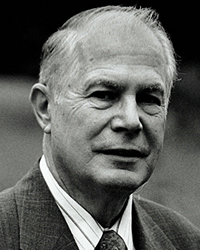 Biography
Robert K. Wagemann
~ October 20, 2004
In 1937, while pregnant with Robert, his mother Lotte Wagemann was arrested due to her activities as on of Jehovah’s Witnesses and briefly incarcerated. She gave birth shortly after being released. Due to stress and limited prenatal care, the delivery was a breech birth, and Robert’s right hip was permanently damaged. His right leg is six inches shorter then the left.
Under the T4 Program, he was classified as handicapped, and twice targeted for extermination. The first time they escape to Berlin, and lived with relatives. The second time was 1943, when his mother was ordered to come with Robert to Schlierbach by Heidelberg to a hospital to be examined. The Nazi Doctor’s confirmed the status of his handicapped condition. During the examination, she overheard a conversation by the Doctor’s that he was to be classified as permanently handicapped, and would be given a lethal injection after lunch. When the Doctors left for lunch, she got Robert’s clothes, picked him up and fled.
Shortly there after their House in Mannheim was bombed and they went to Robert’s Grandparents (father side) to Iggelheim. First day of school Robert did not do the Hitler salute nor sing the national anthem (Deutschland, Deutschland ueber alles…) next day officials from the town came and wanted to pick him up. Due to the interference of his grandpa they left without him.
It was high time to move on, so they went to a town called Haardt by Neustadt a.d. Weinstrasse and lived with Robert’s grandparents (mother side). There in a little cabin in the woods they spent the remainder of the war.
The family survived the war, and in 1963, Robert immigrated with his wife Renate and two of their sons to the United States. They are now married for 45 years have threes sons and five grandchildren.
His mother is still living (going on 90), his father who was also blacklisted as a Jehovah’s Witness and sought after by the nazis, died in 1984.
Robert lives now with his wife Renate in Fairfield, NJ.
Bio of Robert K. Wagemann ~ October 20, 2004
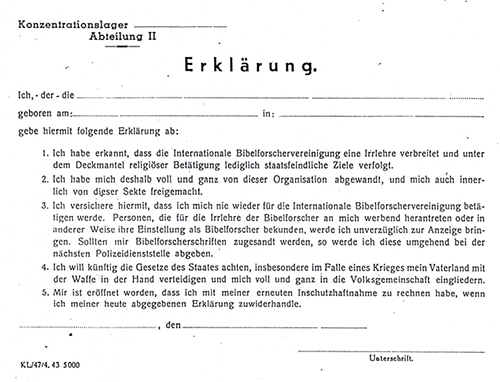
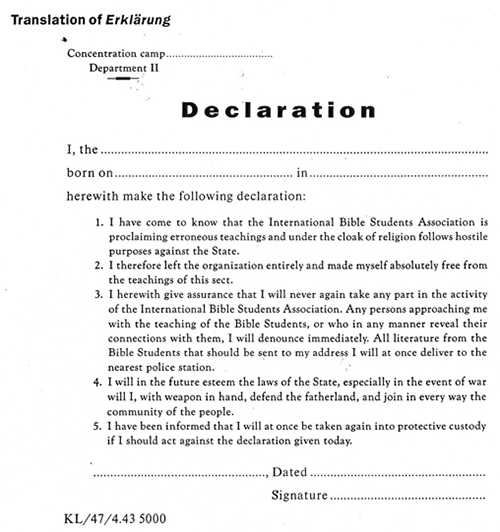
The imprisoned Jehovah's Witnesses were given this document. By signing, they would be renouncing their faith and then released. Of all the Jehovah Witnesses imprisoned, only five out of approximately two-thousand signed the declaration and were released.
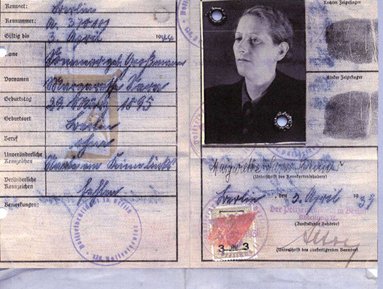
All Jewish females were required to use the middle name of "Sarah" on their passports. The males were required to use the name "Israel" There was a large "J" on the passport cover.
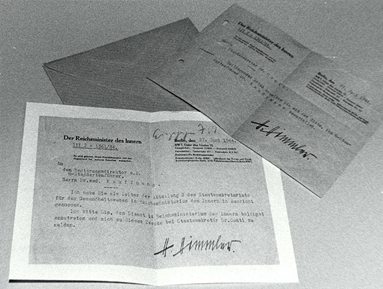
Himmler's Orders
Mein Kampf by Adoph Hitler
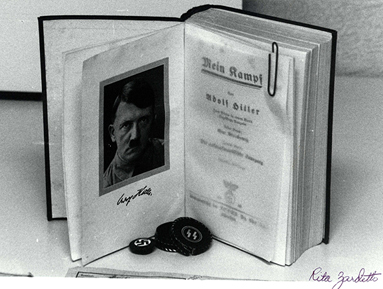
SS Lapel Pin with its orignial Box

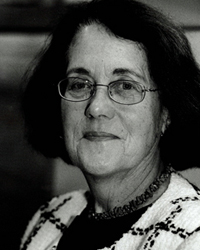
Biography
Ursula Lenneberg Pawel
Ursula was born on April 24, 1926 in Dormund, Germany as a daughter of a ‘mixed marriage’. Her father Otto was Jewish and her mother Caroline was Christian. Her mother converted to Judiasm in 1926. In 1925, Otto became a general manager of the Karstadt department store and her mother became the buyer for children and ladies’ clothing. They lived in a beautiful apartment and led a very nice life surrounded by many relatives. Ursula’s brother Walter was born in September of 1930.
In 1932, Ursula started school in Aplerbeck. Her life changed drastically when Hitler came to power in January of 1933 as Chancellor of Germany and immediately put changes into effect concerning the Jews. Jewish stores and businesses were boycotted and, by 1935, the Germans enacted the infamous Nuremberg Laws. These laws made anti-Semitism official policy and affected 500,000 Jews by depriving them of their German citizenship and placing all kinds of restrictions on them. One restriction forbade Jews to marry Gentiles. In 1934, Ursula was forced to leave her school and entered a Jewish elementary school in Dortmund. She had to travel a half hour by tram to get to school. Ursula was seven years when she experienced the hatred of anti-Semitism when two playmates told her that they could not play with her anymore because she was a Jew. As the result of the persecutions an boycotts, Ursula and her family were forced to move to Dusseldorf in 1936, the birth place of her father and where they had other relatives. Her father opened another dry goods business and Ursula attended a private Jewish school.
On November 9, 1938, her school and synagogue were burned. Kristallnacht (Night of the Broken Glass) changed her life even further. Jews had to adopt Sara and Israel in front of their names; identification papers were stamped with J for Jew in red and, eventually they were forced to wear a yellow star. By 1941-42, the State Secret Police (Gestapo) confiscated everything of value that Jews possessed. Her mother received an order to appear at the police station and was told to divorce her Jewish husband. She simply refused.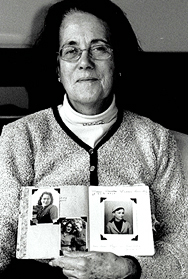
In July of 1942, Ursula received an order to present herself for deportation to a labor camp. Her family wanted to go with her. Her father Otto and brother Walter were able to join her. Each person brought a suitcase along with clothing that the Germans later confiscated for their own use. She was sent to Theresienstadt, Czechoslovakia, a labor camp situated in an old army fortress. This camp was a transit camp to Auschwitz, a death camp located in Poland. In Terezin, she became a youth leader of her block L414 and was placed in charge of teaching them. Her father was a talented carpenter and he managed to get extra rations for them. Her mother also arrange for her to receive packages, which she shared with her charges.
In the spring of 1944, Terezin was undergoing a “beautification” program because they were expecting the Red Cross to come to visit. A bank was opened and ghetto money was printed. Stores were opened, gardens were grown, a library was built and they even had a theater. Children were playing on the pavilion, a choir was singing; only healthy looking Jews were permitted outside. As soon as the Red Cross departed, most of the inmates were sent to gas chambers to die.
In Terezin, the Jews managed to run many cultural events for themselves. They had many talented artists, musicians, painters and professional who used their talents to boost the morale of the prisoners.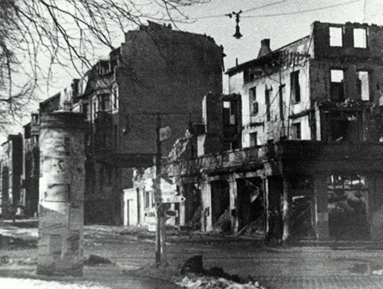 On September 30, 1944, her father and brother were shipped to Auschwitz and murdered in October of 1944. Ursula ended up in Camp c of Birkenau, which was part of the Auschwitz complex. The Germans shaved her head, stripped her of her clothes, and issued a prisoner’s suit – no underwear, no soap, and no towel or utensils. She was stripped of all human dignity. Chimneys were spewing out human ashes; a horrible smell permeated the air. She was eventually selected to do work and was put with non-Jews. There she met other girls and made life long friends.
In the beginning of 1945, Ursula was sent to work in an airplane factory in Silseia. The forman did not like people with glasses and selected Ursula and three of her friends to be shipped back to Auschwitz. The transport was mostly filled with sick prisoners. One soldier put them in the last car and locked the door. Hours later, soldiers joined Ursula and her friends and gave them food. At the train station of Merzdorf/Riesengebirge, the soldiers told them to jump out and follow them. They were handed over to a factory where prisoners were mostly Polish and Hungarian Jews. This saved her life.
In May of 1945, they were liberated by the Russians. Ursula and Bushchi, her good friend from Holland and fellow camp survivor, made a 500-mile bike trek across Germany to a village near the Dutch border where her mother was staying. They traveled asking for shelter and food along the way. Most people responded with kindness. Germany, 1945After a struggle to leave Germany and, with the help of UNRRA (United Nations Relief and Rehabilitation Administration), American Joint Distribution (AJDC) and Hebrew Immigrant Aid Society (HIAS), she and her mother were able to obtain and affidavit and come to America in 1947. It was easier to come to America if you were a German citizen than a citizen of other countries because of the unfilled German quotas. With the help of AJDC, Ursula and her mother settled in Boston. Ursula was helped by a very kind and famous radiologist, Dr Alice Ettinger, Chief Radiologist in Pratt Diagnostic Hospital, and she became an x-ray technician.
Ursula met her husband Hans Pawel and they were married in 1948. Her mother remarried a week later to Siegmund Bruenell. Ursula and Hans have two children. Her husband Hans passed away in 1999. Ursula wrote a book about her experience, My Child is Back, published as part of Holocaust testimonies. She is very actively involved in telling the story of her teenage years and what happened during the Holocaust as a lesson for young people. Today Ursula lives in Bedminster, New Jersey.
SUGGESTED FURTHER READING
Kriskova et al. Secret Magazine of the Boys of Terezin. Jewish Publication Society. Teenage boys in Terezin publish a literary magazine. Grade 7 and up.
Ayer, Eleanor, Helen Waterford and Alfons Heck. Parallel Journeys. Helen and Alfons are born in close vicinity of each other. Helen ends up in a concentration camp and Alfons joins the Hitler Youth. Grade 7 and up.
Matas, Carol. Daniel’s Story. Daniel is a fictitious story based upon a compilation of photographs of children in Germany. 4th – 5th grades.
This is a small portion of the blanket that was issued to Ursula upon arriving at Merzdorf, a labor camp in Poland. At this time, she was assigned the number: 67269. After liberation in May 1945, Ursula and Buschi traveled 500 miles across Germany back to Lippborg. Since there was still fighting, they stitched Dutch flags onto their coats so they would not be arrested or bothered by troops. Also in this image are photos of Ursuala before and after her war experiences. 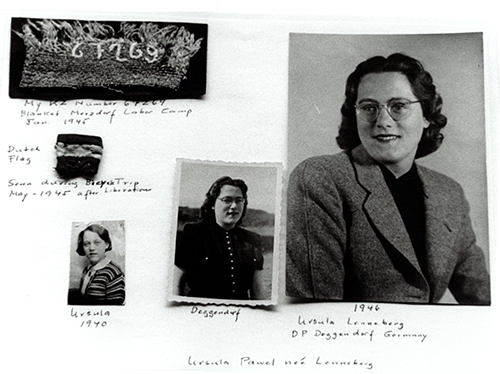
Ursula's Route Across Germany Post-Liberation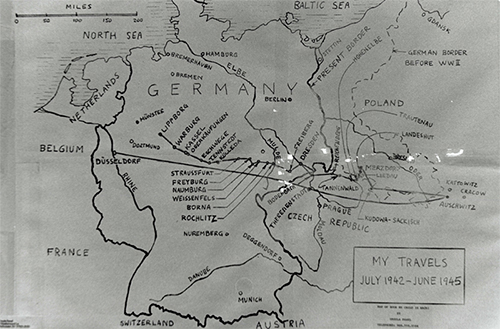
At Theresienstadt, a ghetto in Czechoslovakia, prisoners were forced to write postcards informing their relatives that they were fine and being treated well. This postcard was writted by Ursula's brother Walter, age 14, to his Uncle Erich.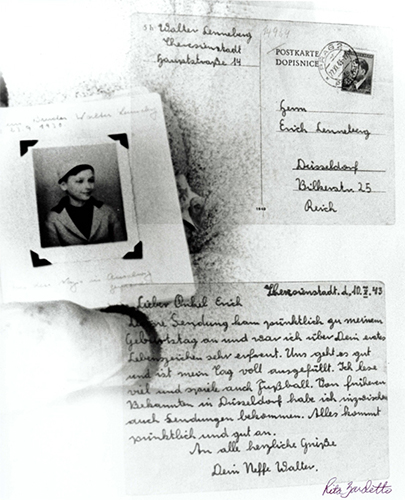
In Theresienstadt, this "fake" money was distributed during the "beautification" for a Red Cross visit in the Spring of 1944.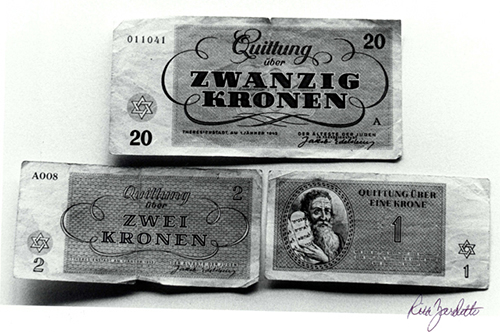
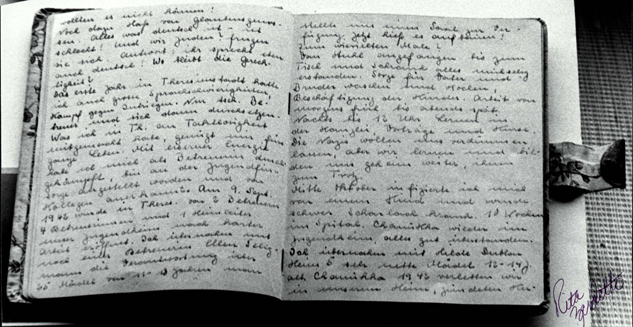
As Ursula rode her bike on hte 500 mile trip back to Lippborg after liberation in 1945, she began writing notes of her experiences. Upon arriving there, she transcribed her notes into this diary. It is her most prized possession.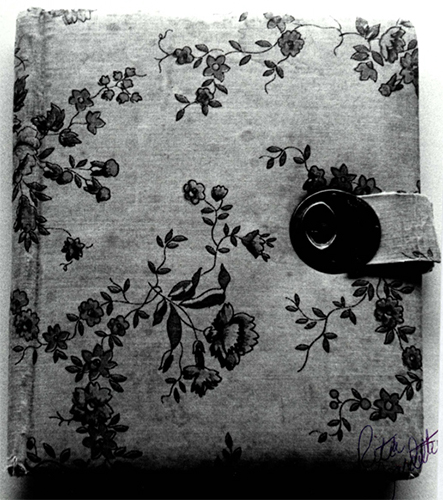
Biography
Margit Buchhalter Feldman
Margit, the only child of Joseph and Theresa Buchhalter was born in Hungary on June 12, 1929 in Budapest. Her parents had an orthodox home. They lived in Tolcsva near the Czechoslovakian border; a small agricultural town numbering about two thousand people with Jews making up one tenth of the population. Margit had fond memories of her early childhood and looked forward to the celebration of holidays and the Sabbath. Margit attended parochial school that was supported by the government. There were about sixty Jewish children in her town and they attended Jewish day-school. As a child, Margit was conscious of the prejudice against the Jews. Religious children dressed differently and suffered from discrimination by their non-Jewish peers. In 1941, Margit attended school in Budapest and lived with her relatives for a while. The Jews were already suffering from a set of discriminating laws that were implemented against them in the late 1930’s. Margit was brought home because her parents feared for her safety.
Margit’s father Joseph owned a general store and suffered from economic decline because he was forbidden to carry and sell certain merchandise such as sugar, coffee, flour and various oils. These products required coupons and Jews were not permitted to sell them. In the summer of 1943, her father and two uncles were ordered to report to an assigned location in order to be taken to a forced labor camp. While her father and uncles were away working on a farm, her mother Theresa ran the business and Margit helped with many of the chores. He was released shortly before the German occupation in March of 1944. The Arrow Cross, an extreme right-wing nationalistic Hungarian group started their own “Final Solution” of the Jews before Passover of 1944. 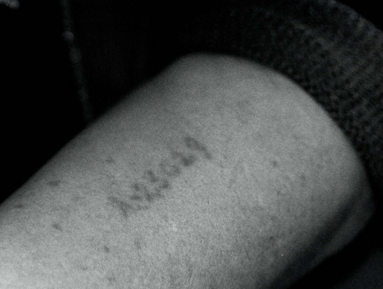
The Buchhalter family and many other Jews were imprisoned in a ghetto of Satoraljaujhely, a nearby town. From there Margit and her family were shipped to Auschwitz, a death camp in Poland. In Auschwitz Margit who was 15 years old lost her protective parents and clung to her aunts who survived the selections for death. She told the Nazis that she was eighteen and this made her eligible for forced labor. She was transferred to Crakow to work in a quarry for a little while and then sent back to Auschwitz. During her second stay in Auschwitz she became aware of the terrible experiments on twins that were being conducted by infamous Dr. Josef Mengele.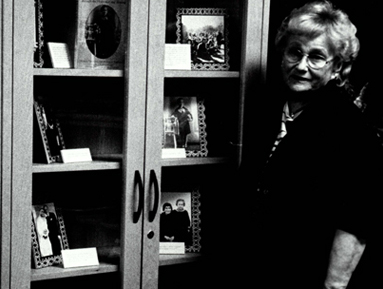 In early winter of 1944-45 she was shipped to work in a munitions factory in a camp called Grunberg, a subcamp of Gross Rosen in eastern Germany; that camp was not as harsh as Auschwitz. Margit and the prisoners had a little more food to eat. There she met Gerda Weiss Klein, a well known Holocaust survivor and writer. Margit was taken on a death march to Bergen Belsen. She was liberated on April 15, 1945 in Bergen Belsen by the British, a very sick young girl of sixteen, all alone and without family. She was injured by an explosive set by the Germans intending to destroy the camp and had pleurisy and pneumonia.
Margit was fortunate to be sent to Sweden to recover after the war and received kind treatment by the Swedish people. She found out that she had an aunt and uncle in the United States and joined them in August of 1947.
When Margit came to the United States she was still sick and it took her a number of years to recover. After she recovered she became an x-ray technician. This is when she met her Harvey Feldman, they were married in 1953 and have two children Tina and Joseph and three grandchildren, Caryn, Joshua and Zachary.
Margit has devoted her adult life to teaching children about the Holocaust and doing community work. She has dedicated herself to helping the powerless and vulnerable. The book: Margit- A Teenager’s Journey through the Holocaust and Beyond written by her and Bernard Weinstein has become recommended reading for children studying the Holocaust and distributed by the State of New Jersey Commission on Holocaust Education. Margit is a staunch supporter of Raritan Valley Community College Institute for Holocaust and Genocide Studies, and helps to create an annual spring program which three-thousand students attend each year to learn about the Holocaust and Genocide.
SUGGESTED RESOURCES
Holliday, Laurel ed Children of the Holocaust and World War II and Their Diaries-Grades 7-12 Covering all the countries that were involved during WWII
Atkinson, Linda. - In Kindling Flame: Story of Hannah Senesh- Grade 7-12- Telling of young Jewish Heroine who tried to help Hungarian Jews
Bierman, John - Righteous Gentiles: Story of Raoul Wallenberg, Missing Hero of the Holocaust- Grade 9-12 Detailed account how he saved thousand of Jews by issuing them Swedish passports.
Bitton-Jackson, Livia- Elli: Coming of Age in the Holocaust Grade 9-12- Tells story how she miraculously survived the war as a teenager
Bitton-Jackson, Livia- I have lived a Thousand Years: Growing Up In the Holocaust- Grade 5-10 A younger adaptation of the above book
Isaacson, Judith Magyar-The Seed of Sarah: Memoirs of a Survivor Grade 10-12 Joyful life in Hungary and then Auschwitz
Block, Gay and Malka Drucker- Rescuers: Portrait of Moral Courage in the Holocaust Grade 9-12 Forty nine people in many countries risked their lives to save Jews.
INTERNET SITES
- Council of Holocaust Educators
- great site for Educators
- United States Holocaust Museum, Washington, DC
 Biography
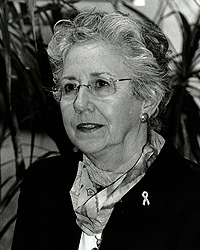
Maud Peper Dahme
Maud was born in Amersfoort, Holland on January 24, 1936, the daughter of Hartog and Lilly Peper. Her sister Rita was born on February 23, 1938. Her father Harry was a restauranteur and her mother Lilly a homemaker. The Germans invaded Holland in 1940; the Jews were relatively unmolested until the beginning of 1941, until the Germans set up Jewish Council. In the fall of 1941, all Jewish children were forced to leave public schools and study under the supervision of the Jewish Council. This affected Maud’s studies and she was forced to leave her school.
In July of 1942, German officials in Holland ordered all Jewish families to report to the train station with a single suitcase of their belongings which upon arrival to the camps was confiscated. Several thousand Jews were arrested and shipped to Westerbork, a camp in Holland. The next day a thousand were sent to Auschwitz. By October of 1942, 13,000 Jews were seized for shipment. Maud’s family was warned by a family friend who had ties to the underground of the upcoming arrests and shipments to camps and gave them the address of a safe house. Maud age 6 and her sister age 4 were separated from their parents and went into hiding. Her parents were helped in their town by another family. Righteous Rescuers who hid Jews took great personal risks and acted very courageously, if caught the consequences were very serious and even possible death.
Three years of hiding in Oldebroek and two families later Maud was reunited with her parents; she did not want to go home with them because she did not know them. The post-war years were very painful for Maud and her parents; they learned that all of their relatives had perished.
Maud and her family came to United States in 1950 to rebuild their lives. Maud recalls how she was placed in fourth grade as a fourteen year old girl. She and her sister Rita devised a system of learning English by attending the movies every day and staying all day all for the cost of a quarter; thereby she was able to jump to the seventh grade the following school year. She graduated high school with her peers. College was out of reach because of lack of money.
Maud has become a champion for children of migrant workers and is a member of the Interstate Migrant Education Council of New Jersey. She has dedicated the last twenty four years by serving on her local school board and presently she is in the 25th year as a member of the New Jersey State Board of Education where she has served as Vice President and President. As a victim of the Holocaust she has set out to ensure that today’s children will have a quality public education, something that she was not able to get during the war years.
Maud is a very active member of New Jersey Commission of Holocaust Education and plays an active role ensuring that the Holocaust not be forgotten by teaching students to accept differences through her story of survival. Speaking about her Holocaust experience is a recent activity. She visits many schools to teach young people what happens when a nation is stripped of their civil rights. When the Commission sponsors summer teacher seminars on the Holocaust and genocide with visitations to camp sites, Maud accompanies the educators on their learning trips by sharing her experiences as a young child in hiding and relating the courageous behavior of her rescuers.
She married Hank Dahme in 1957 and they had four children and nine grandchildren. Hank passed away in 2001.
SUGGESTED RESOURCES
Reiss, Johanna- The Upstairs Room- Grade 5-10 Tells the story of a Dutch Jewish girl that hides for 2 ½ years with a farmer
Reiss, Johanna- The Journey Back- Grade 5-10- Same young girl is reunited with her family in Holland after the war
Von der Rol, Ruud and Irann Verhoeven- Anne Frank Beyond the Diary: A Photographic Remembrance- Grade 5-12 Collection of known and unknown photographs of Anne Frank and her family
Gille, Elisabeth-Shadows of a Childhood: A Novel of War and Friendship- Grade 7-12, Hidden in the French countryside tells the experiences of her two sisters that were hidden in a Convent.
Moskin, Marietta - I am Rosemarie Grade 7-12 Born in Holland she is sent to Westerbork transit camp then to Bergen Belsen
Vos, Ida - Anna is Still Here Grade 5-10, 13 year old Anna is hidden in Nazi-occupied Holland
Adler, David - Hiding from the Nazis Grade 3-6 True story of Lore Baer who at the age of four was place with a Non-Jewish family in the Dutch countryside
Greenfield, Howard - The Hidden Children- Grade 4-10 Tells the story of many hidden children during World War II
Stein, Andre - Hidden Children: Forgotten Survivors of the Holocaust - Grade 10-12, Hidden children in Europe written for older children
INTERNET SITES
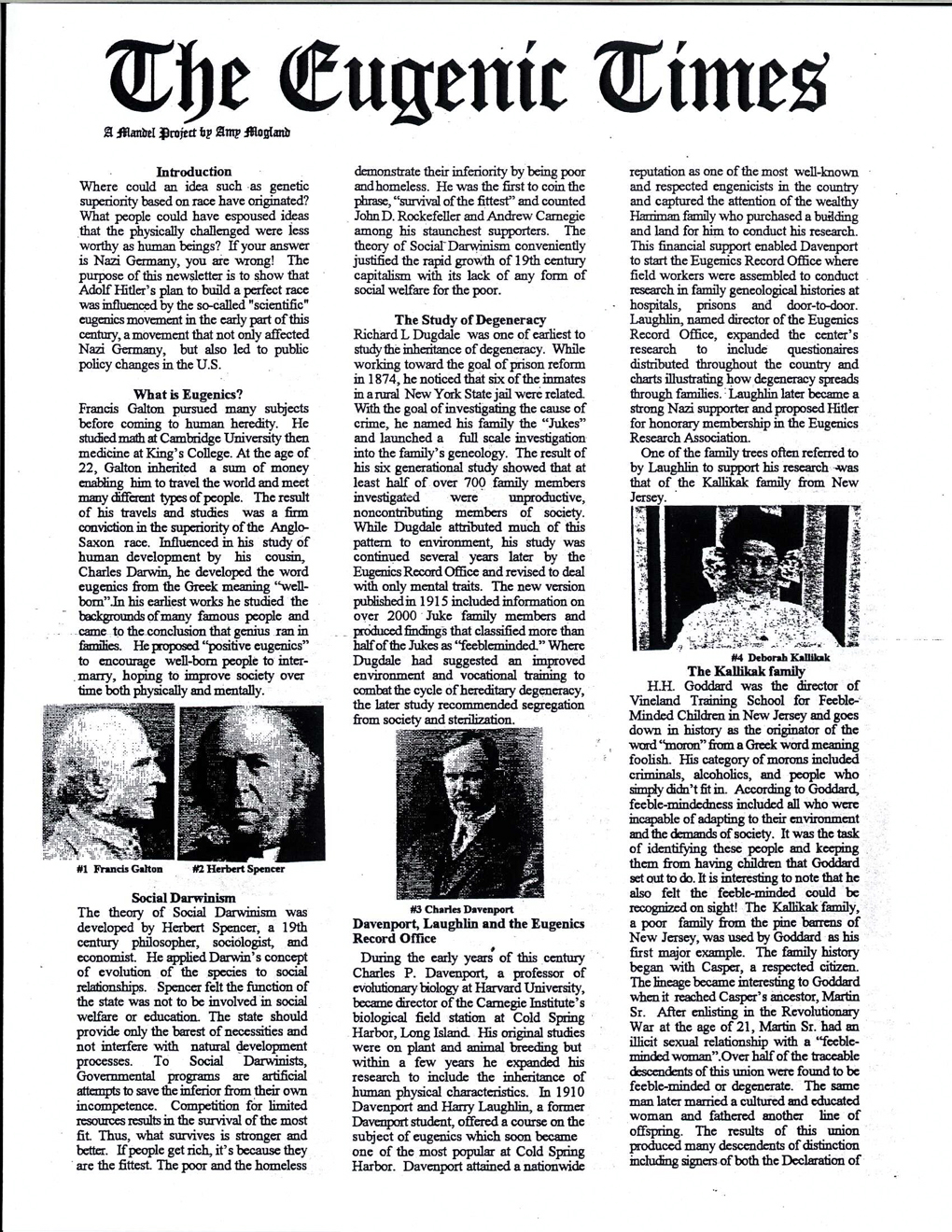
The Eugenic Times a Mandel Project by Amy Mogland
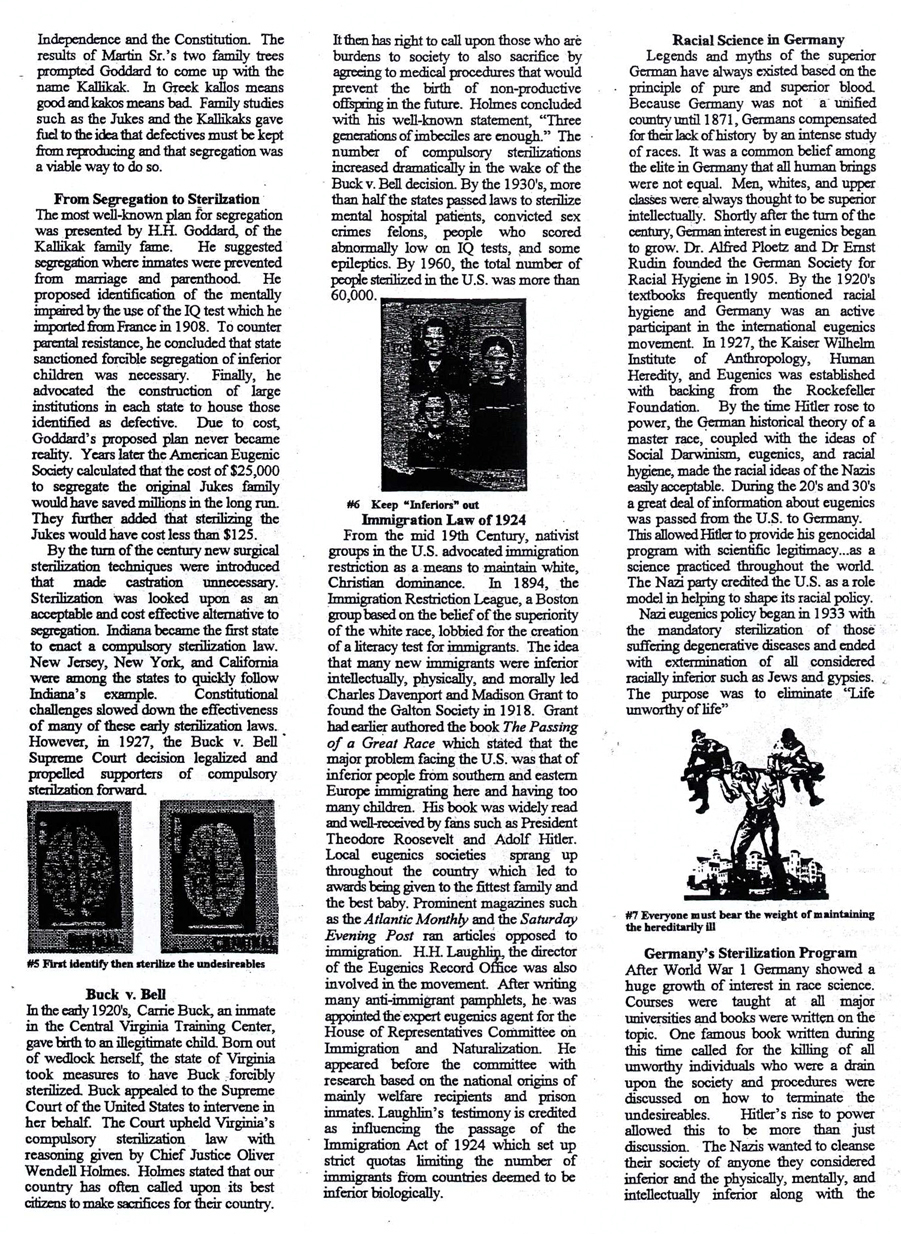
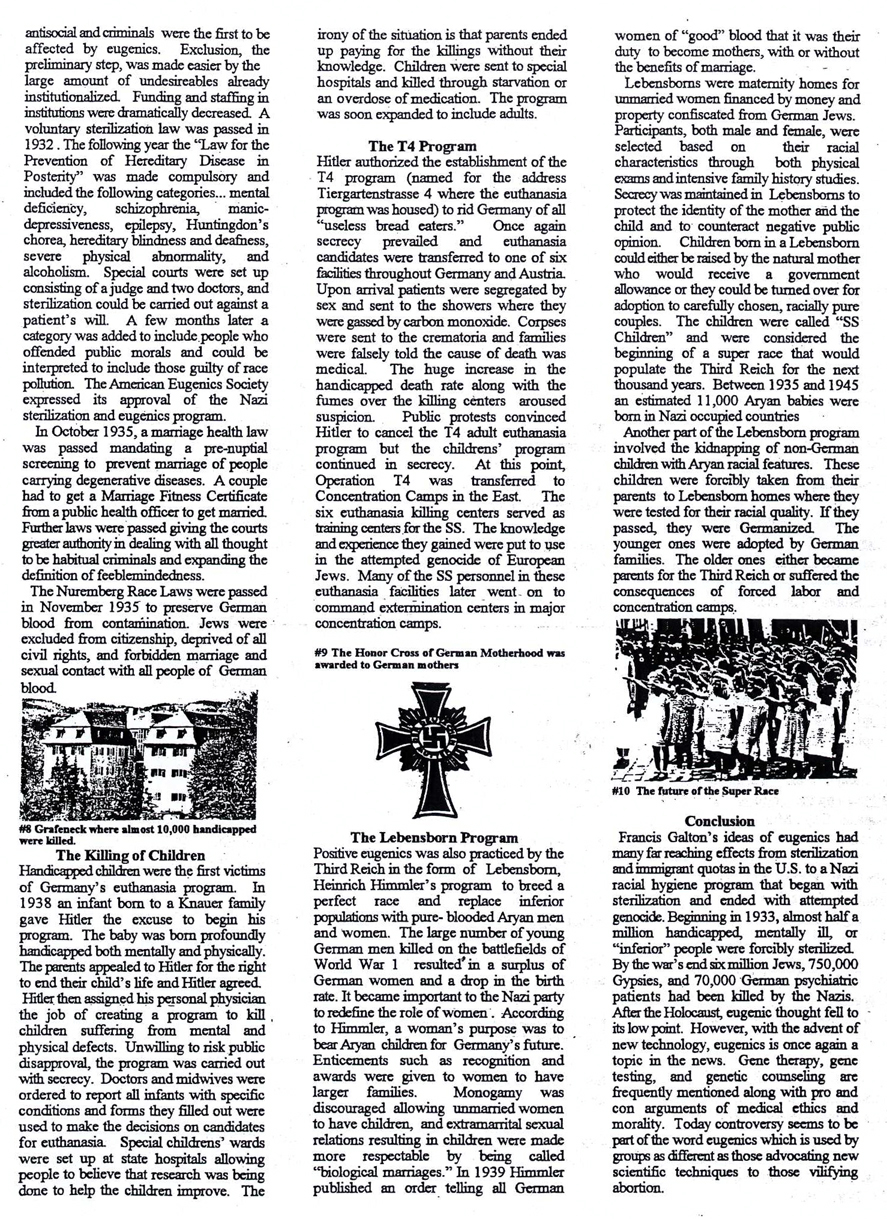
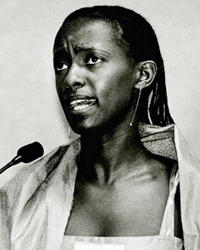
Genocide continues in the world today.
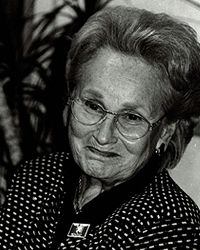
Pictured below is Yvette Rugasguhunga, who is a Rwandan genocide survivor, speaking about her experiences.
The Above Memorial Pages were created by:
Rita Danca Zardetto
Rita Danca Zardetto is from the Chicago area and has had a passion for photography since winning a Brownie camera in third grade. She has an Associate in Arts Degree from William Rainey Harper College in Palatine, IL and also attended the American Academy of Art in Chicago.
She worked for United Airlines for 18 years and moved to New Jersey in 1988. She quit her full-time job after the first of her two children was born. Rita has been taking several photography classes at RVCC, wanting to turn to photography as a second career.
Rita felt strongly about being part of this project, hoping to contribute in some way to the messages of the Holocaust survivors to future generations. It has been an insightful learning experience, and she will never forget the survivors who have touched her heart.
The Legacy Project
RVCC Service learning projects provide students with a number of unique opportunities. The Legacy Project is an outstanding example of how service learning student, Rita Zardetto, integrated her academic course work with service. Ms. Zardetto created the photo exhibit for the Legacy Project, as part of her studies in Commercial Photography II. The project enabled her to apply photography skills while learning about the Holocaust from the survivors who provided oral history interviews and artifacts. RVCC is very grateful for the contributions of Ms. Zardetto and the survivors who have made this project possible.
Addressing Antisemitism
The Institute of Holocaust & Genocide Studies strives to educate RVCC students and the larger community about people’s capacity for inhumanity and injustice and their equal ability for compassion and resiliency. Antisemitism, one of the many issues to be confronted, is strikingly prevalent and problematic in the U.S. and around the world.
In an effort to bring understanding and clarity to this problem, we are working to educate the community about the terminology and the corresponding actions that constitute antisemitic acts. The International Holocaust Remembrance Alliance has a working definition of antisemitism, which has been adopted internationally in order to raise awareness and combat this issue. For additional information, visit the International Holocaust Remembrance Alliance website at https://www.holocaustremembrance.com/working-definition-antisemitism
Resources are available for the RVCC Community through the RVCC Evelyn S Field Library. Please see our Antisemitism resource guide
The U.S. Strategy to Counter Antisemitism
https://bidenwhitehouse.archives.gov/wp-content/uploads/2023/05/U.S.-National-Strategy-to-Counter-Antisemitism.pdf
Remarks by President Biden on the October 7th Terrorist Attacks and the Resilience of the State of Israel and its People | Tel Aviv, Israel
Wednesday, October 18, 2023
https://www.youtube.com/watch?v=BEX_vUkKLMo
Attorney General Merrick B. Garland Delivers Remarks at the Anti-Defamation League’s Never is Now Summit
Thursday, March 7, 2024
https://www.justice.gov/opa/speech/attorney-general-merrick-b-garland-delivers-remarks-anti-defamation-leagues-never-not